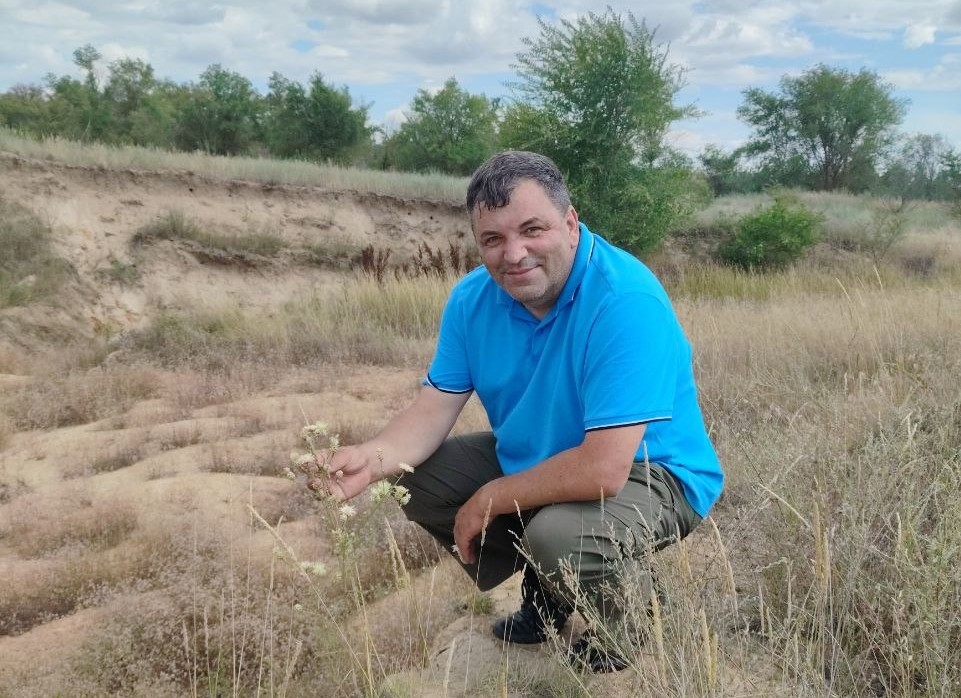

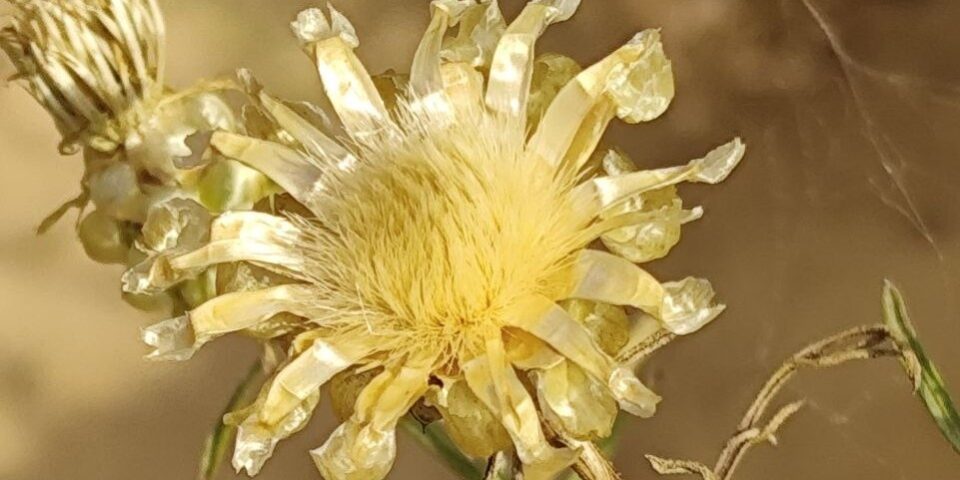
Scientists from the Ukrainian Nature Conservation Group recently conducted an expedition to the lower reaches of the Inhulets River to assess how the war has affected the region’s steppe ecosystems. They examined vegetation growing on military fortifications, in bomb craters, and across other war-damaged sites. One of the expedition’s key objectives, however, was to assess the status of the Pachosky’s cornflower (Centaurea paczoskii), one of Ukraine’s rarest plant species.
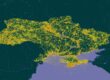
Pachosky’s cornflower is a truly remarkable botanical treasure. It is an endemic species found only on the sandy terraces of the lower Inhulets River. Its entire natural range is confined to a single municipality—the Kalynivka community in Kherson Region. There are only a handful of comparable examples of such narrowly distributed endemic plants in Ukraine.
During the war, every known population of the species was located within the active combat zone. Additional threats included wildfires, the construction of military fortifications, and flooding following the destruction of the Kakhovka Hydroelectric Power Plant dam. The water level also rose in the Inhulets River, reaching almost to the sites where this species grows. For these reasons, the researchers sought to determine whether the plant had managed to survive these challenges.
Only two localities of the species are currently known—near the villages of Novohredneve and Bobrovyi Kut. The total population consists of just over 2,000 individual plants. For a steppe species, such a small population size places it on the very brink of extinction. Combined with its extremely restricted range, this means that Pachosky’s cornflower faces a genuine risk of global extinction.
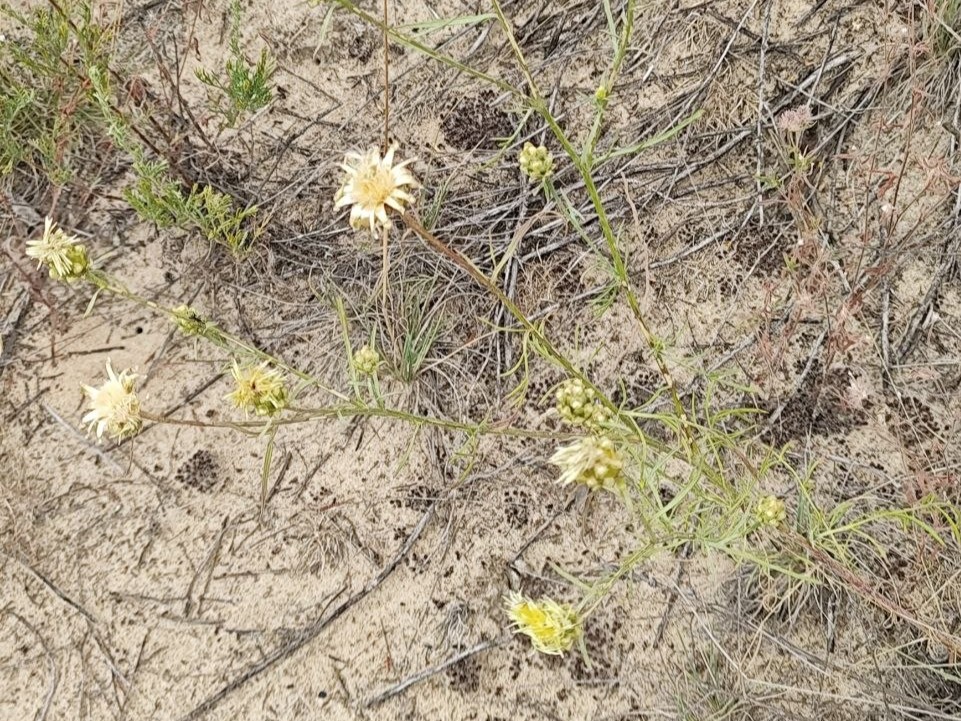
Botanist Ivan Moisiienko explains the remarkable story of the species’ discovery and rediscovery:
“For many years, Pachosky’s cornflower was believed to be extinct. It was first collected by Józef Paczoski in the early twentieth century, who mistakenly identified it as a Central Asian species. In the 1930s, Mykhailo Kotov demonstrated that it was a distinct species previously unknown to science and named it in honour of Paczoski, who had first discovered it. After that, no one recorded the species again for nearly eighty years, and it was widely considered extinct.”
Moisiienko recalls that in 2008, while preparing materials for the third edition of the Red Data Book of Ukraine, he organized a dedicated expedition to search for the species. Fortunately, the effort was successful.
“We found the cornflower exactly where Paczoski and Kotov had recorded it decades earlier. Near Novohredneve, only about 150 plants remained because much of the sandy habitat had been afforested with pine trees. Near Bobrovyi Kut, however, the population was considerably larger, with around 2,000 individuals.”
According to Moisiienko, the species faced serious threats long before the full-scale invasion.
“Several years ago, there were plans to completely afforest the area near Bobrovyi Kut with black locust (Robinia pseudoacacia). We prepared a scientific assessment demonstrating why afforestation would be highly damaging to the local ecosystems. Besides Pachosky’s cornflower, the site also supports several other protected plant species, including Limonium graminifolium, Stipa borysthenica, and Stipa capillata. Today, new threats have emerged as well—demining operations, possible sand extraction, and post-war reconstruction.”
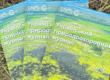
To protect Pachosky’s cornflower, we proposed the establishment of two protected areas: the Bobrovyi Kut Nature Reserve (651 hectares) and the Novohrednevska Nature Monument (21.5 hectares). Brief descriptions and maps of these proposed protected areas were published in our 2020 monograph Prospective Protected Areas of Kherson Region.
We are convinced that establishing legally protected areas is the only reliable way to ensure the long-term survival of this species.
“Pachosky’s cornflower is hanging by a thread. Unless we protect its habitats now, we may lose forever a species that exists nowhere else on Earth,”
Moisiienko emphasizes.
During the July 2026 expedition, botanists Ivan Moisiienko and Tymur Bedernichek visited the smaller of the two known populations near the village of Novohredneve. The area remains heavily mined, making a thorough survey impossible. Nevertheless, they succeeded in locating Pachosky’s cornflower. Despite extremely intense military activity, the species has survived at this site.
The researchers also met with the leadership of the Kalynivka community to discuss establishing protected areas where the species occurs. At present, neither of the two known localities has any legal protection. We hope we were able to convince local authorities of the urgent need to safeguard Pachosky’s cornflower—a species that represents the unique natural heritage of their community.
Protecting such irreplaceable natural heritage is also about protecting our identity. It is, after all, for the preservation of our identity that Ukraine continues to fight and pay such a terrible price.