
The Ukrainian Nature Conservation Group has published more than one million records of plants, animals, and other organisms on GBIF. But the value of these data goes far beyond the number itself. Open biodiversity records are used for scientific research, conservation decision-making, and preserving information about Ukraine’s natural heritage during wartime.
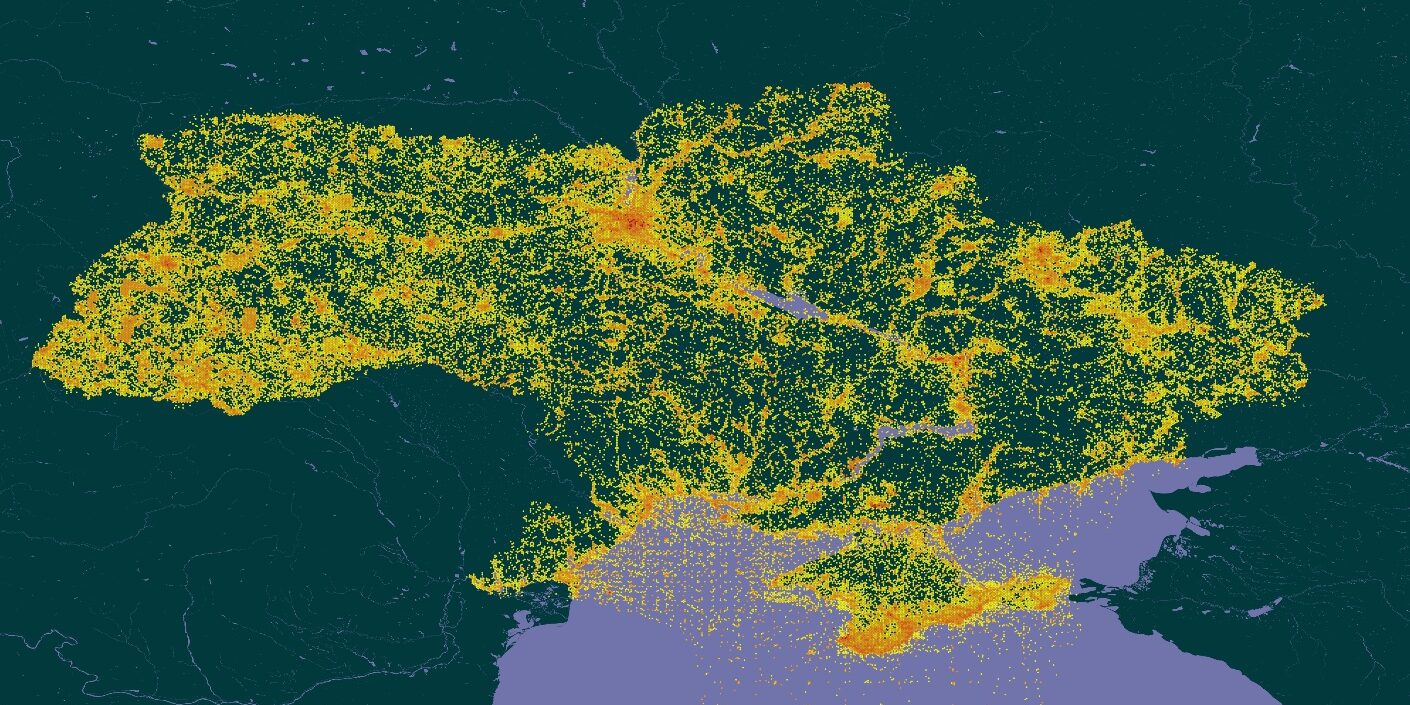
As of today, the Ukrainian Nature Conservation Group’s GBIF page contains more than one million records. According to the Group, this amounts to 1,056,487 records, 352 published datasets, and more than 1,200 citations. UNCG has been a GBIF data publisher since 20 August 2020.
The journey to this milestone did not begin with a large-scale digitization programme. It started with fairly routine work: learning how to turn the biological data accumulated by researchers into structured records that could be read and used by international databases. We spoke with Oleksii Marushchak, UNCG co-founder and an expert in herpetology, herpetoculture, and conservation, about reaching the first million records on GBIF and what this means for Ukrainian science.
From One Dataset to One Million Records
The Ukrainian Nature Conservation Group registered as a GBIF data publisher in August 2020. This marked the beginning of systematic work to publish Ukrainian biodiversity data.
“The journey to the first million started around 2020,” Oleksii Marushchak recalls. “That was when we registered as publishers on the platform. Then, in January 2021, I got COVID and spent two weeks at home. I needed something to do while I was isolating. Oleksii Vasiliuk and Oleh Prylutskyi suggested that we create and publish the first dataset ourselves. It was very large. I had to learn how to format it properly according to the Darwin Core standards. I started getting the hang of it, and eventually, for the next several years, I worked with GBIF datasets in one way or another almost every week.”
Over the years, working with biodiversity data has developed into a separate area of the Group’s activities. Today, UNCG has hundreds of published datasets. These include not only the results of its own field research, but also material collected by other scientists, conservationists, and citizen activists. Among the more recent datasets, for example, there is data collected by 142 researchers from across Ukraine. There are also datasets extracted from hundreds of historical journals, as well as descriptions of collections that were destroyed during the full-scale war. Gradually, we became a data publisher capable of making other specialists’ materials available as well.
What Does One Record Actually Mean?
GBIF is a global infrastructure for open biodiversity data. Its purpose is not simply to collect as many photographs of animals or herbarium specimens as possible, but to make data available in a structured form that can be used by researchers, conservationists, and government institutions.
“This is very important because it is the main international data platform focused on aggregating biodiversity data. It makes it possible to bring together many different types of information,” Oleksii Marushchak explains. “It is publicly accessible worldwide and open, meaning that the data can be downloaded free of charge. We can store biodiversity data there, and they will remain accessible for as long as the server on which they are stored continues to exist.”
A record in such a system can come from a field observation, a museum collection, an old scientific publication, or an observation made by a citizen who photographed a plant or animal and uploaded the photograph to iNaturalist. That is why one million records do not mean one million identical points on a map. They represent a vast body of diverse information about encounters with species that can be combined, compared, and analysed.
It is particularly important that the data can not only be viewed but also cited as a scientific resource. Each GBIF dataset is assigned a DOI, making it possible to track its use in scientific publications.
According to Oleksii Marushchak, UNCG data are already being actively used in scientific publications.
“These data are not just sitting there. Our datasets are cited in specialist scientific journals. There are papers on the impacts of war, species distributions, extinctions, research related to COVID, and many other topics. The more data we preserve and the more data we upload, the better. Every published record can eventually become part of a study that we do not even know about today.”
Data That Cannot Be Lost
Open data have acquired particular importance since the beginning of Russia’s full-scale invasion of Ukraine.
Before the war, information about plant and animal observations might have seemed like a purely academic matter. But when a territory becomes inaccessible because of hostilities, occupation, landmines, or destruction, an old record can become the only evidence that a particular species once lived there.
The war has also led to an increase in initiatives aimed at preserving such materials. Oleksii says he worked on at least three small grant projects that helped collect data from people who had been forced to leave their homes.
“People became internally displaced, saving their collections, diaries, records — everything they could preserve when they were forced to leave areas affected by hostilities or frontline territories,” the scientist says. “As far as I remember, around one hundred thousand records were collected through just three such small projects. Other colleagues were working on this in parallel, and there were other grant initiatives, including those focused on digitizing museum collections.”

Oleksii Marushchak, Chief Data Manager for Emerald Network, Natura 2000 and GBIF
In this context, digitization is more than a way to make science more convenient. It makes it possible to preserve information about the nature of territories that researchers may not be able to access for years.
“The importance of these data has taken on a new meaning. It is no longer just a point — I saw a frog, or I saw a moose. Every such observation that has been recorded and preserved somewhere has its own value and purpose. Perhaps that frog or that moose will never be there again…”
How a Map Can Help Create a Protected Area
One of GBIF’s most practical advantages is the ability to see data spatially rather than as individual records. If a particular area contains a large number of observations of rare species, this can provide an argument for protecting it.
“GBIF data are used to create new protected areas and expand existing ones. GBIF clearly shows: here, this rare animal has been recorded; here, another rare species has been recorded. And that is an argument that requires no additional explanation,” Oleksii emphasizes. “You can simply show an official or a community leader: look, there are many rare species in this forest, wetland, or steppe ravine. Then you can open the specific table, check the source and the observer, contact them, and, if necessary, verify the information.”
The ability to verify information is one of the important features of open data. A record does not appear out of nowhere: it has a source, an author, a date, geographic coordinates, and other characteristics. If an error or inaccuracy is identified, the data can be clarified or corrected.
In August 2026, we reported on the establishment of Chornyi Lis National Nature Park in Kirovohrad Oblast. Among other factors, this landmark achievement was made possible by natural history data accumulated over decades becoming part of modern conservation decision-making.
Not Just for Scientists
GBIF may seem like a platform exclusively for professional biologists. In fact, a significant share of its data comes from citizen science.
Platforms such as iNaturalist and Minka allow ordinary users to photograph living organisms, upload their observations, and receive help identifying species.
“Anyone can register using their email address, photograph whatever they are interested in, and upload their observations. You see a beautiful flower, take a photograph, upload it, someone helps you identify what it is, and that data may eventually also reach GBIF. Not as UNCG data, of course, but as part of a dataset from the relevant platform,” Oleksii says. “We in the Group are not monopolists, and we have never aimed to be. What matters is that the observation will be used, will remain accessible, and can become part of the bigger picture.”
For an iNaturalist user, this means that their observation can remain on the platform and, unless specific restrictions apply, may eventually be included in GBIF. According to Oleksii, updates do not happen instantly, but the data are synchronized regularly.
Thus, reaching one million records is not only the result of the work of the people who prepare datasets. It is also the result of the efforts of dozens and hundreds of researchers, museum professionals, conservationists, and ordinary nature observers.
Among other Ukrainian data publishers, we have helped several newly established organizations publish their first datasets. Since our registration, their number has increased significantly. There are currently 39 registered data publishers in Ukraine, and we provide support to all of them in one way or another. This number continues to grow.
What Can One Million Records Tell Us?
Open data make it possible to answer questions that cannot be addressed through a single field study.
They can be used to model species distributions in relation to climate change, refine the current ranges of rare organisms, and track the emergence of invasive species. The ability to compare data from different years is particularly valuable.
“When you conduct research, you cannot be in one place all the time. You need some background information. It may be available in scientific publications, but publications are relatively rare. And even then, you still need to extract the raw data you need from them, and those data are very rarely published. That is why having such raw data openly available is so important. If I am asked today to assess a particular site before construction, I can go there and see what is there now. But on GBIF, I can find out what someone recorded in that area yesterday, a year ago, or ten years ago. That gives me much more information — from different years and seasons, and under different conditions,” Oleksii explains.
The data can also be useful for tracking invasive species. When an organism begins appearing in new regions, individual observations can help reveal the direction of its spread before the problem is detected by traditional monitoring systems.
Ukraine and the Challenge of National Monitoring
In European countries, GBIF is just one source of information used to assess the state of biodiversity. The situation in Ukraine is more complicated: there is effectively no comprehensive national biodiversity monitoring system. As a result, open data carry much greater weight.
“In Europe, GBIF is only one part of the reporting system. Our situation is different. If there is no national biodiversity monitoring system, GBIF provides a much larger share of the information needed for such assessments. Without it, we would not be able to report on many things, we would miss many species, and assessing the distribution of rare species would take much more time. For example, when preparing a new edition of the Red Data Book, you could spend millions of person-hours going through libraries and looking for who saw a particular plant or animal and where. Or you can use GBIF and obtain this data much faster,” Oleksii Marushchak says.
At the same time, GBIF does not replace comprehensive monitoring. Individual records cannot show everything that is happening to a population and do not automatically answer every question. But they provide a huge body of evidence from which analysis can begin.
Oleksii Marushchak compares this role to that of a crutch: it does not replace a healthy leg, but it allows a person to move much farther.
One Million Is Just the Beginning
Crossing the one-million-record mark does not mean the work is finished. On the contrary, every new record increases the value of the data already accumulated.
Today, GBIF contains not only new observations. Archival materials, old scientific publications, and digitized collections are also being added. One of UNCG’s recent datasets, for example, contains species distribution data extracted from rare Ukrainian scientific publications from the early twentieth century.
In other words, the digital database is gradually becoming a kind of memory of Ukrainian nature — from old publications to observations made today. This is particularly important for territories that are changing faster than we can study them.
War, fires, landmines, forest destruction, changes in river courses, construction, and climate change all mean that today’s record may become tomorrow’s historical evidence. That is why one million GBIF records are not simply a large number. They represent one million occasions on which someone saw a living organism, identified it, recorded where and when it was found, and left that information for others. Some of these points will help scientists build models of species distributions. Some will support the creation of protected areas. Some will help us understand how the war has changed nature. And some may become the only evidence that a particular species once lived in a particular place.
And the more of this evidence is preserved openly, the harder it becomes to say that we knew nothing about the nature of a given territory. Because now it has a digital memory.