

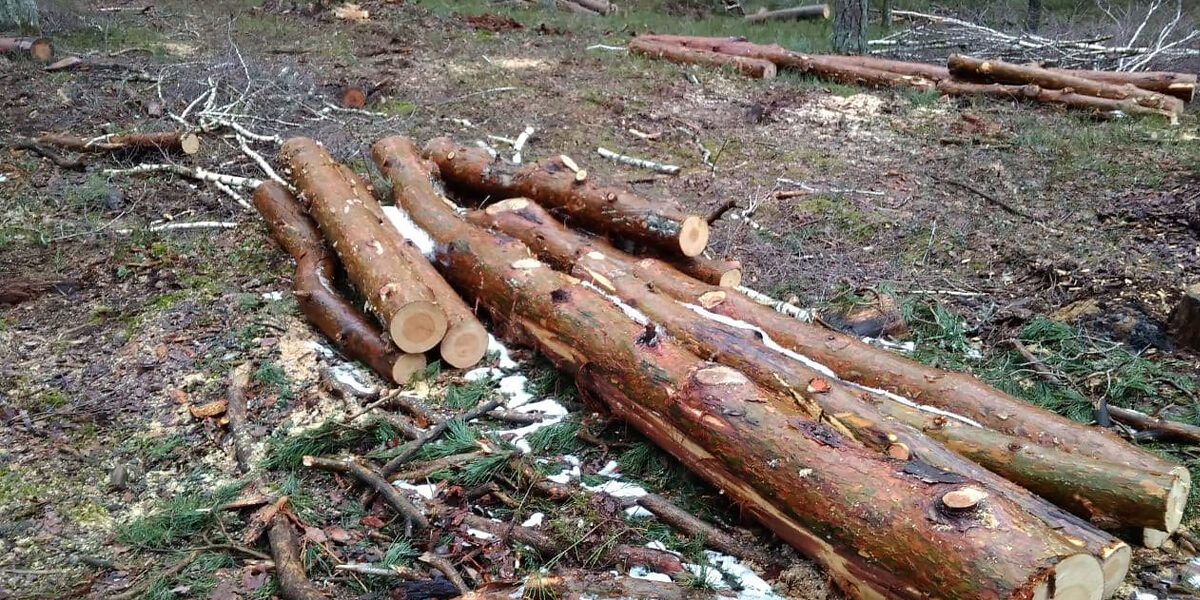
The Ukrainian government recently adopted new amendments to its timber harvesting regulations. While many of the changes are technical, legally formalizing practices that were already in use, there are also some notable new provisions.
The most significant change is the introduction of fire-resilient edge cuts. Foresters can now thin out forests at the boundaries between coniferous forests and settlements, fields, or other areas prone to fire. This allows for additional preventative “burn-off” to reduce the amount of flammable material. These cuts are not permitted in Protected Areas (PZF) and serve as an alternative to the destructive clear-cuts previously used for creating firebreaks, which completely eliminate the forest.
Another key change is the new restriction on building forest roads. It is now forbidden to construct forest roads in nature reserves (zakaznyky), a practice that foresters previously abused. For example, in the “Zubr” reserve in the Volyn region, roads were built through a protected area. The new rules stipulate that all plans for road construction must be included in the forest management plan, which must be approved by the Ministry of Environmental Protection and Natural Resources of Ukraine.
In national parks, trees that are felled due to being hazardous must now be left in the forest as deadwood, rather than being removed. This rule excludes areas within settlements and forests with the highest fire risk.
It’s difficult to say whether these new rules will be better for nature. Given the anti-environmental stance of the state-owned enterprise “Forests of Ukraine”, there’s a risk that they will abuse and manipulate the new types of cuts, as they did with “reformation cuts” in the past. Therefore, much will depend on the Ministry’s position during the approval of the forest management plans.
For our part, we will be monitoring this closely.