
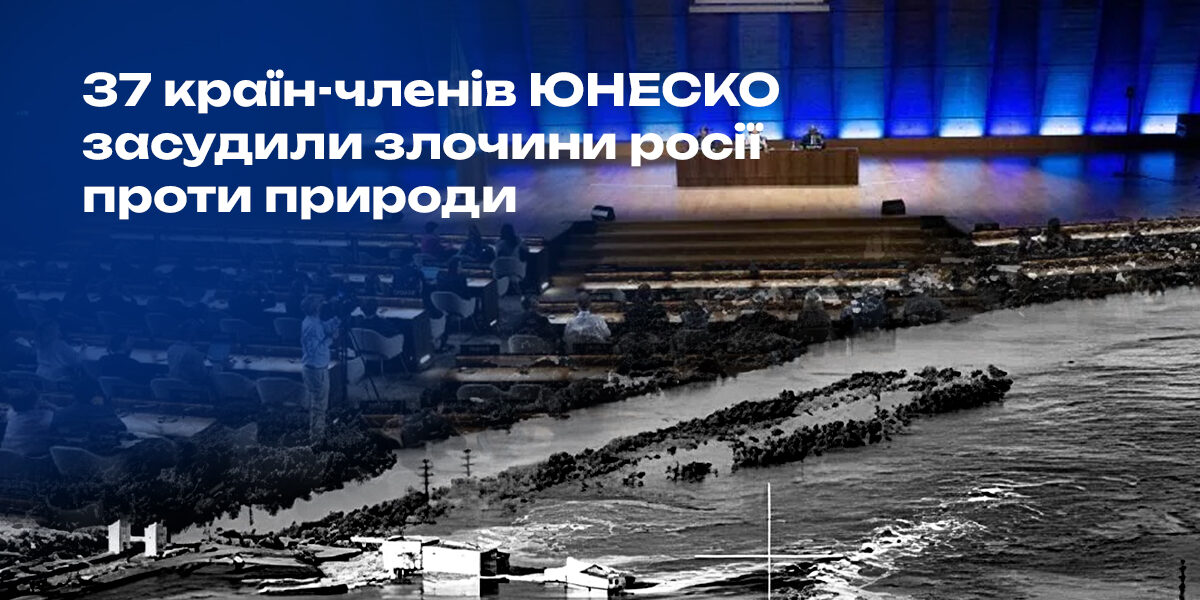
On behalf of 37 countries, Denmark has condemned Russia’s illegal war against Ukraine and its environmental consequences during the 36th session of the International Coordinating Council of the “Man and the Biosphere” Programme (MAB). Russia was called upon to cease its aggression and fulfill its international obligations under the Programme and international environmental law.
This marks the first such statement within a UNESCO setting since the start of the full-scale invasion.
The statement addressed the damage to Ukrainian biosphere reserves, particularly the Black Sea Biosphere Reserve and Askania-Nova, which are both located in Russia-occupied territories.
The statement also mentioned Russia’s destruction of the Kakhovka Dam on June 6, 2023. The catastrophic flood affected 620 km² of land and numerous protected areas. UNESCO experts participated in a Post-Disaster Needs Assessment for the Kakhovka Dam disaster and found significant environmental damage.
Denmark also welcomed several important UNESCO initiatives. One is to support Ukraine through scientific monitoring and data collection on biodiversity and ecosystems in the affected reserves. Another is to strengthen environmental journalism in Ukraine to raise awareness about the war’s impact on protected areas and their local communities.
The delegation emphasized the importance of maintaining the war-affected reserves within the World Network of Biosphere Reserves and requested that the Secretariat provide an update on any aid plans for Ukraine in light of a periodic review.
As expected, Russian representatives at the session called for the Programme not to be politicized. The delegation of the Russian Federation accused Kyiv of blowing up the Kakhovka Dam and expressed their readiness to discuss Ukraine’s environmental problems. They cited “data” on alleged crimes committed by Ukraine in the east since 2014.
They also brought up an interview with Viktor Havrylenko, the former director of “Askania-Nova,” regarding environmental violations in the reserve due to its military use. They asked the delegations why they had never raised this issue before. The Russian delegation also claimed that their government is currently working on restoring the protected area.