

We have prepared a comprehensive proposal for the expansion of the Protected Areas Fund (Pryrodno-Zapovidnyi Fond, PZF) in the central part of the Kharkiv region (Kharkivshchyna). The six nature reserves (zakaznyky) we propose for establishment are well-known to scientists and already hold European conservation status.
Previously, the former composition of the regional administration categorically opposed the creation of reserves in the zone of interest of leaders from the “Opposition Bloc” in the Parliament (Verkhovna Rada) of Ukraine. We hope that there are now no obstacles to the Kharkiv region designating these conservation areas of European significance as protected areas.
Kharkiv Region: One of Ukraine’s Lowest-Protected Areas
This history began several years ago. The Kharkiv Regional State Administration previously refused scientists’ requests multiple times to establish new reserves in the territory of what is now the Chuhuiv district. Conservationists last received such a refusal in 2018, which was also the last year the Kharkiv region significantly expanded its PZF. In 2021, protected status was granted to a total area of only 33.5 hectares, and since then—for almost four years—not a single new protected site has been established in the region.
The area covered by the PZF in the Kharkiv region currently stands at only 2.38%, placing the region in the second-to-last position in Ukraine. Kharkivshchyna is one of the few regions that has essentially halted the creation and development of its PZF for many years. Furthermore, many of the region’s existing protected territories have suffered damage due to military actions, making it necessary to not only increase the number of protected areas but also to compensate for lost ecosystems with new designations.
European Integration and Legal Obligations
One of the prerequisites for Ukraine’s accession to the European Union is the adaptation of national legislation to the EU Birds Directive (2009/147/EC) and the EU Habitats Directive (92/43/EEC). These directives, among other things, mandate the creation and functioning of the Natura 2000 network of protected areas. The reserves we proposed seven years ago perfectly meet the requirements for the European Emerald Network (the pan-European equivalent of Natura 2000, which covers Ukraine). If these reserves had been established, it would have directly moved us closer to fulfilling EU requirements.
Ukrainian law explicitly mandates the expansion of the PZF area. This is stated in the Law of Ukraine “On the Basic Principles (Strategy) of the State Environmental Policy of Ukraine for the Period until 2030” and in the Cabinet of Ministers of Ukraine Resolution No. 695 (August 5, 2020). These documents require the expansion of the PZF area to 15% of the country’s territory. Parliamentarians also repeatedly drew attention to this goal during committee hearings on October 24, 2024, issuing a directive to the Ministry of Environmental Protection and Natural Resources and local authorities to prepare materials for the establishment and expansion of protected areas, including in temporarily occupied territories.
Our New Proposal for Six Landscape Reserves
We are aware of the complex situation in the Kharkiv region due to the full-scale Russian invasion and the ongoing destruction of natural ecosystems. It is precisely because of this that we are striving to help the region and local specialists preserve the unique habitats that can still be saved.
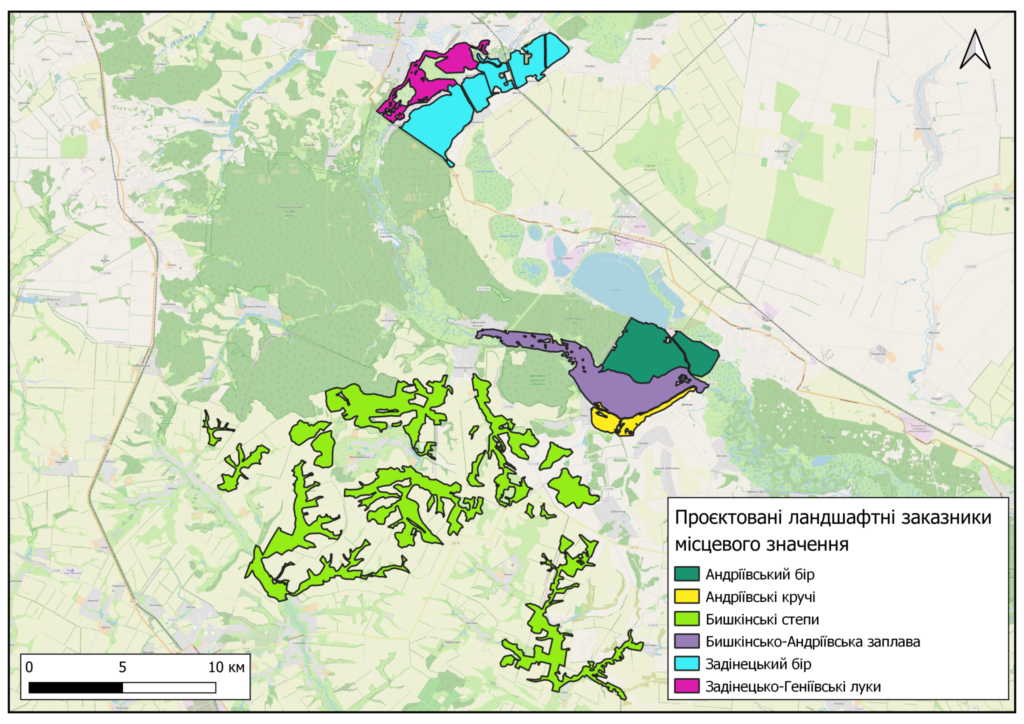
Following scientific field expeditions, we, together with Kharkiv scientists, prepared a new and even more thorough petition for the establishment of six local landscape reserves (zakaznyky): “Andriivskyi Bir,” “Andriivski Kruchi,” “Byshkinsko-Andriivska Zaplava,” “Byshkinski Stepy,” “Zadinetskyi Bir,” and “Zadinetsko-Heniiivski Luky.”
These six new landscape reserves cover unique natural complexes of the Kharkiv region, including forests, steppes, floodplain meadows (zaplava), marshes, and wetland habitats. They are home to rare and endangered plant species, such as the slender gladiolus (Gladiolus tenuis), the small fritillary (Fritillaria minor), and the marsh helleborine (Epipactis palustris). Furthermore, these territories serve as centers for numerous animal species, many of which are listed in the Red Data Book of Ukraine and international conservation lists.
All of the proposed reserves have been officially granted Emerald Network status. The decision was adopted by the Standing Committee of the Bern Convention in December 2019. However, the lack of a dedicated Ukrainian law on Emerald Network territories prevents these areas from being truly protected, meaning Ukraine is not fulfilling its European integration commitments. Ideally, these territories should also be granted Protected Areas Fund status.
Exceptional Value and Political Urgency
The conservation, scientific, and aesthetic value of these reserves is undeniable. They play a vital role in maintaining the hydrological balance, preserving biodiversity, and ensuring ecosystem stability. Additionally, the scenic landscapes and rich flora and fauna support the development of ecotourism, scientific research, and conservation programs.
We are convinced that the establishment of these reserves should not be delayed, as their territory remains vulnerable to destruction. Several years ago, our proposals included not only these sites but also the “Polyhon” reserve in the Horila Dolyna tract, a site known to Kharkiv conservationists. This incredible center of biodiversity—the type locality for some animal species—has been almost entirely plowed over in recent years (and ironically still retains the status of defense land).
The political aspect is no less important. These territories are already part of the Emerald Network and are under the scrutiny of European conservation institutions. Despite this, they remain unprotected in Ukraine largely due to the former (and possibly ongoing) interests of the leader of the “OpoBlock,” Yevhen Muraiev. It is obvious that modern decisions regarding these territories must be guided by completely different priorities.
Prepared with financial support from the International Charitable Organization “Ecology – Law – Human” as part of the TEDJusticeROL project.