
Although it was not widely publicized, starting in late 2023, the Ministry of Environmental Protection and Natural Resources (Min dovkillia) finally adopted a strong, state-minded position on the extraction of widespread mineral resources.
Ministry officials had been effectively blocking attempts to auction off plots of land containing peat, amber, and sand if those plots fell within Protected Areas Fund (PZF) sites, forests, or if their extraction could lead to significant damage to water resources. This approach directly complied with the principles of various national strategies, such as the Forest Strategy, which explicitly prohibits transferring forests for other types of land use if alternatives exist—and for these common minerals, alternatives almost always exist!
We know this because we have been analyzing all such land plots approved by the Ministry for almost two years. Therefore, we were extremely unpleasantly surprised to see a completely opposite decision recently.
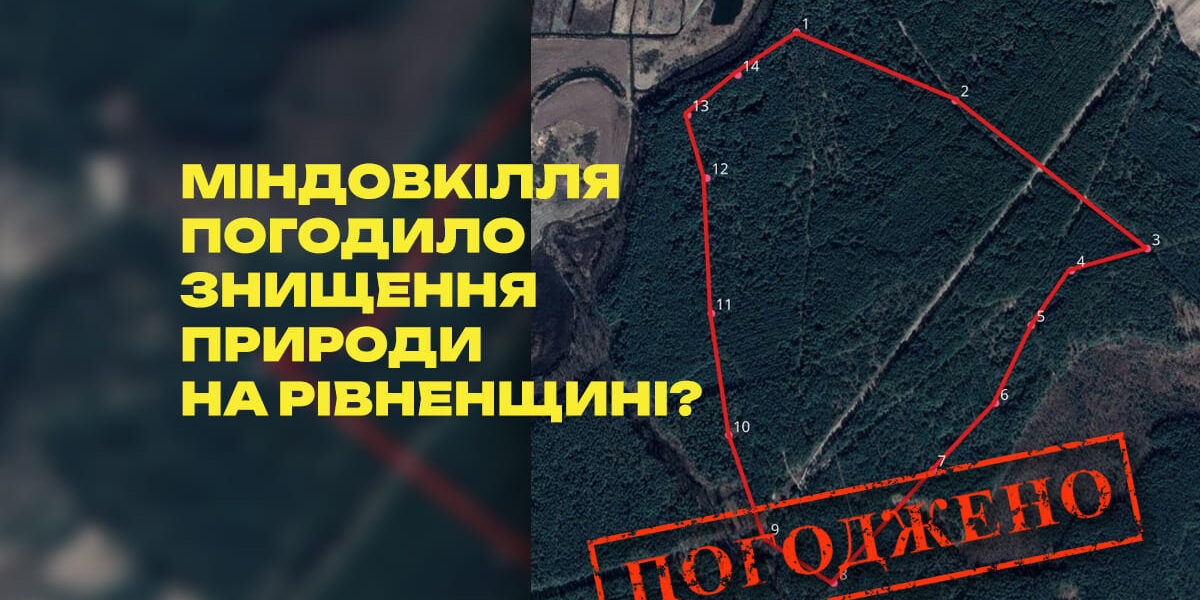
In May-June 2025, the Ministry agreed to allocate several plots in the Rivne region (Rivenenshchyna) for quarrying:
- “Pokrovska” plot (Amber): 12 hectares of forest approved for extraction.
- “Korchyn” plot (Sand): 60 hectares of forest approved for extraction.
No less concerning is the “Sadova 85” plot, a portion of which is a wetland/bog that borders the area designated for the expansion of the Rivne Nature Reserve.
Were there alternatives? Absolutely! The region is full of sites already damaged by illegal amber mining and plenty of agricultural lands where sand could be extracted.
Frankly, this is baffling. How can the Ministry simultaneously speak about the critical importance of preserving forests and immediately agree to their destruction? How can they attract funds from international donors for the restoration of drained wetlands and simultaneously facilitate the degradation of comparable wetlands just a few kilometers away?
The Illusion of Environmental Conditions
There is no reassurance in the fact that Ministry officials included rigid environmental conditions for extraction in their approval – such as stipulating that “the use of the plot is permissible provided there is no impact on the ecological character and hydrological regime.”
Experience shows that once a business pays the state millions of hryvnias at an auction for an extraction license, they will inevitably use political pressure to secure the necessary Environmental Impact Assessment (EIA) Conclusion/Decision that favors their project. The only factors that might prevent this are furious public resistance and major scandals.
We call on the Ministry of Environmental Protection and Natural Resources to cease this shameful practice and revert to the protective stance they maintained over the past few years.
Ultimately, the global situation can only be truly fixed if the EIA procedure for subsoil use is conducted before the auction takes place, rather than afterward.
This publication was prepared within the framework of the project “Nature-Based Solutions in Open Wetlands Restoration for Biodiversity, Water Quality Improvement and Climate Mitigation.” The project is executed in partnership with the Snowchange Cooperative (Finland) and Ogólnopolskie Towarzystwo Ochrony Ptaków (OTOP) (Poland), and is supported by the Nordic Council of Ministers (NCM).