
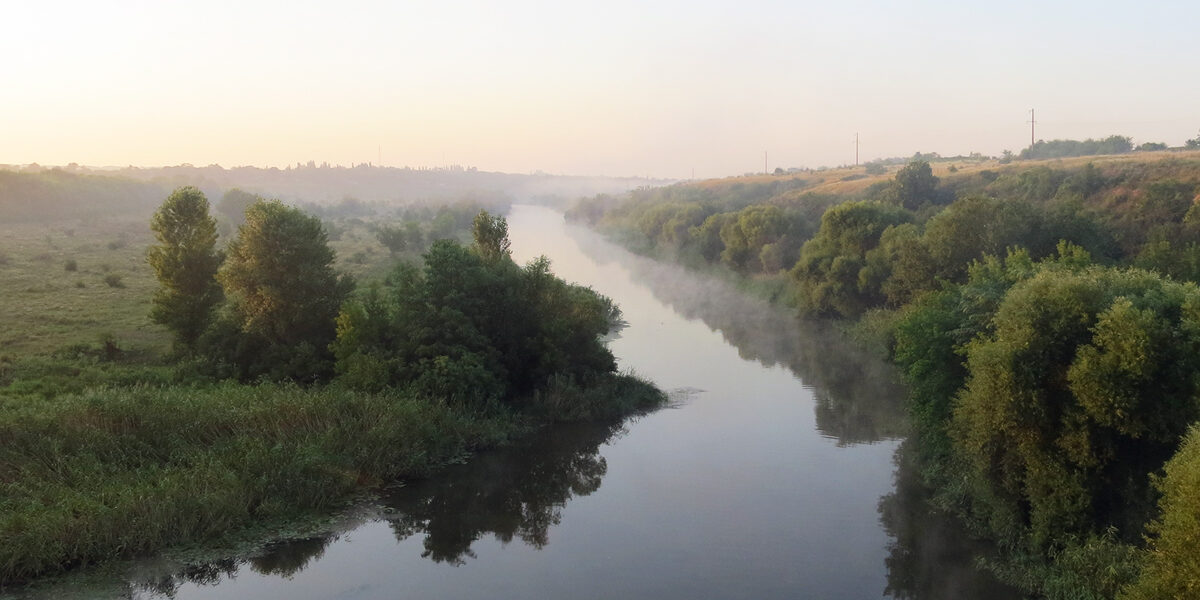
The Ukrainian Nature Conservation Group (UNCG), together with representatives of the state-owned enterprise “Forests of Ukraine” (DP “Lisy Ukrayiny”) and the Vilshanska community, recently surveyed the territory of the planned “Veselkovyi” nature reserve in the Kirovohrad region.
The survey covered a total of 53.17 hectares on the right bank of the Syniukha River near the village of Dobrianka. Plot 1 belongs to the Vilshanska community, while Plot 2 was transferred by the community to “Forests of Ukraine” for planned afforestation.
The establishment of the reserve will help preserve these steppe areas in their near-natural state.
On Plot 1, with its numerous granite outcroppings and steep terrain, we found a number of rare plant species with varying protection statuses. Three of these are listed in the Red Book of Ukraine, which is the national list of endangered species: the Pasque flower (Pulsatilla pratensis), the hairy feather grass (Stipa capillata), and the Siberian Serratula (Serratula lycopifolia). The latter also has an NT (Near Threatened) status on the national list of the IUCN Red List and is included in Appendix I of Resolution 6 of the Bern Convention.
Nine other species on this plot are considered rare in the Kirovohrad region: Cystopteris fragilis, Iris pumila, Muscari neglectum, Rosa spinosissima, Primula veris, Jovibarba globifera, Asplenium septentrionale, Azyneumia glaucum, and Borisov’s stonecrop (Sedum borisovae). The latter is a narrowly localized endemic species of the southern foothills of the Dnieper Upland, meaning it is found nowhere else in the world outside of Ukraine.
Plot 2 has a gentler relief and lacks granite outcrops. Due to intense, unauthorized sheep grazing, it was largely unsuitable for research. We only found a few locations of hairy feather grass, which were mapped in case of future protection.
In 2021, Plot 2 was identified as a habitat of Resolution 4 of the Bern Convention, specifically E1.2 “Perennial herbaceous calciphyte communities and steppes.” The optimal time for surveying steppe habitats is May to June. Therefore, we plan to re-examine the area next year to find spring ephemeroids and identify diagnostic species of steppe communities once they have recovered from overgrazing. We have submitted a proposal for these additional surveys to the Vilshanska Village Council and “Forests of Ukraine.”
The necessary documents for the establishment of the “Veselkovyi” reserve and six other landscape reserves are currently being approved by the community. We hope that Ukraine’s Protected Areas Fund will soon be expanded with these new sites, helping to fulfill legal requirements for increasing the percentage of protected land.