
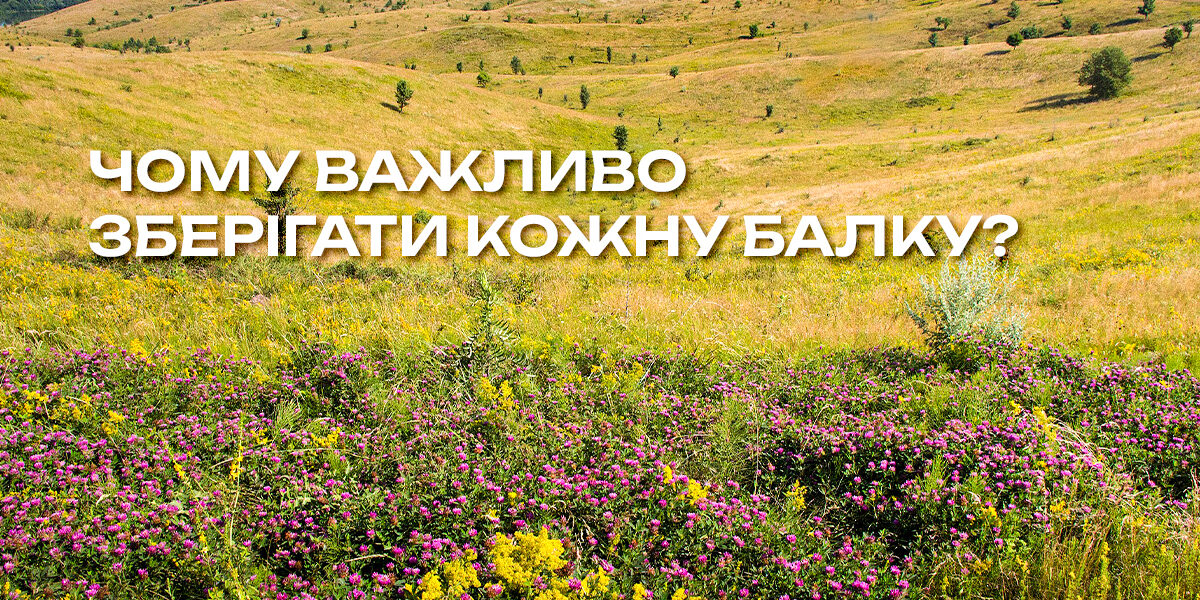
Our colleague, Lyubov Ilminska, has summarized a three-year study of the meadow-steppe ravines (or balkas) on the right bank of Central Ukraine. The study covered hundreds of sites in the Cherkasy, Kyiv, Vinnytsia, and Khmelnytskyi regions. An ordinary, unassuming piece of steppe turned out to be a habitat for over 2,000 species of living organisms.
“Every average-sized meadow-steppe ravine in the Cherkasy region that includes shrub vegetation and a wet lowland serves as a habitat (i.e., foraging grounds, breeding sites, wintering areas, etc.) for 9 species of mammals, 50 species of birds, 2 of reptiles, 1-2 of amphibians, 1,800 of invertebrates, 200 of plants, 150 of fungi, and 3-5 rare species of organisms,” Lyubov writes in her post. This shocking statistic only includes species that can be identified from a photograph; detailed studies could significantly increase these numbers.
Furthermore, the research confirms the importance of steppe habitats not only for steppe inhabitants but also for forest and aquatic species. For example, the European pond turtle (Emys orbicularis) needs steppe slopes to lay its eggs, and the European badger (Meles meles) often settles in steppe ravines far from forests. In winter, these meadows become a vital food source for migrating birds, most of which are typically forest species.
The Undervalued Importance of Every Piece of Steppe
These findings challenge the common misconception that a few preserved ravines are enough to save nature. Large mammals and birds of prey require vast feeding grounds. Moreover, even relatively sedentary populations of small animals like insects and plants need constant genetic exchange with neighboring territories. Isolation and the complete lack of opportunities for genetic diversity within a population lead to its gradual degradation. Each area also has unique microclimatic, soil, and biocoenotic characteristics. Favorable conditions for specific rare plant species to thrive might exist in one ravine but not in a neighboring one.
These analytical summaries are based on a “transect” survey method and, despite several years of observations, do not claim to be a formal scientific study. However, the primary goal is to provide a clear and tangible understanding of what we lose with every plowed ravine. As of 2021, only about 2.5-3% of meadow-steppe ecosystems remain in the Cherkasy region, yet the survival of the entire wild meadow-steppe nature of the Cherkasy area depends on these few remaining percentages.
We hope that those who make decisions about the “development” of the remaining virgin lands will see more than just hectares that are not being used for profit.