

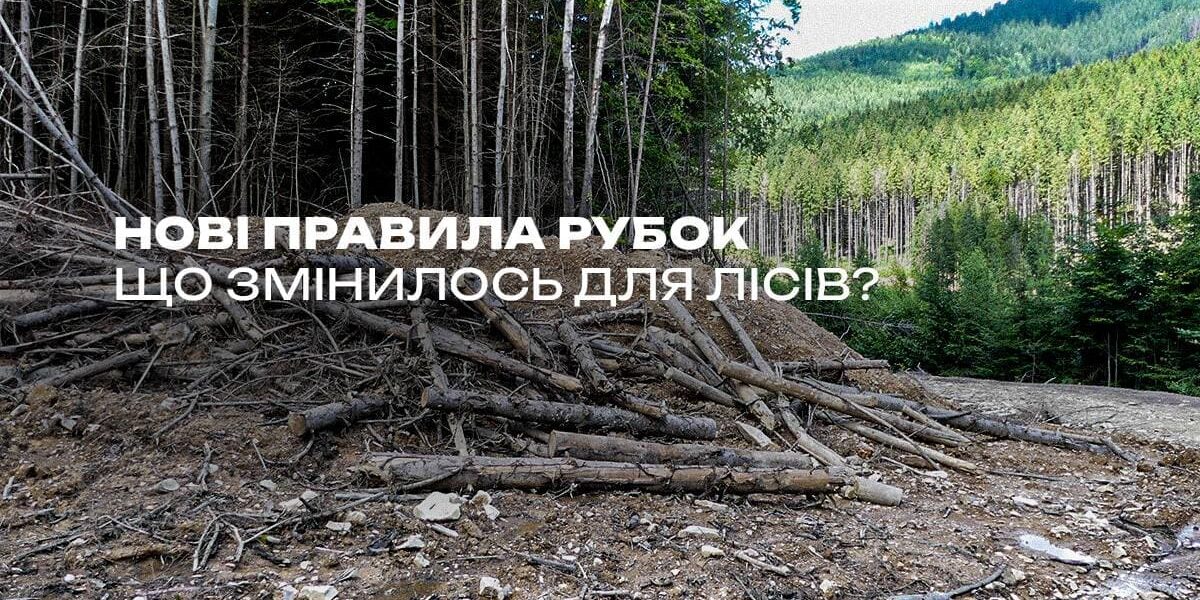
On June 18, 2025, the Government of Ukraine (Cabinet of Ministers) adopted a resolution “On Amendments to Certain Resolutions of the Cabinet of Ministers of Ukraine Regarding Specific Issues of Special Use of Forest Resources.” This resolution introduces several significant changes to timber harvesting rules.
We have analyzed the changes and categorized them into key blocks relevant to the international conservation community.
-
Commission Surveys for Harvesting
Previously, most logging activities not planned under Forest Management (lisovporiadkuvannia) required special commission surveys.
- Changes to Sanitary Felling: The requirement for commission surveys has been excluded for sanitary felling (logging of diseased or damaged trees). These are now subject only to the requirements of the “Sanitary Rules,” which concern forest health and safety.
- Public Notification and Composition: This is a partial positive change. Permanent forest users—such as the State Enterprise “Forests of Ukraine” (DP “Lisy Ukrainy”), communal forestries, and National Nature Parks (NNPs)—must now provide 10 days’ advance notice of these surveys on their websites.
- Mandatory PZF Representation: Representatives of Protected Areas Fund (PZF) institutions must now be mandatory members of these commissions within their administrative territory. (The resolution is vague on regions, such as the Carpathians, where multiple PZF institutions exist within one area.)
- Decision-Making: The public may participate, but decisions are made by simple majority vote.
Assessment: The mandatory inclusion of PZF representatives and the public notification requirement are positive steps toward transparency. However, since the decision is based on a simple majority, foresters can still potentially push through their proposals (e.g., building new forest roads in the Carpathian highlands or Polissia wetlands) even if PZF and public representatives object.
-
Scientific Research Felling
The new rules allow harvesting for scientific purposes that deviate from standard legislative requirements.
- Restrictions: These cuts are strictly prohibited within PZF sites, primeval forests, and especially protective forest areas.
- Conditions: They must be conducted only with the accompaniment of scientific institutions, must align with the subjects of scientific research, and are limited to an area no larger than 0.5% of the total area of a single forest district (lisnytstvo).
- Transparency: Research plans for these cuts must be published on the website of the State Forest Resources Agency (Derzhlisahentstvo).
Assessment: Such “scientific” cuts are arguably necessary for climate change adaptation research. However, past practices (e.g., using “scientific justification” from universities to conduct massive reformative logging in the Carpathians) show that the goals of these cuts can easily become distorted. There are huge risks that this pretext will be used to harvest timber in areas where other types of logging are restricted or forbidden, such as high-altitude forests.
-
Regulation of Preparatory Harvesting Work
The resolution introduces clear legislative definitions for terms like “felling area” (lisosika) and “skidding trail” (trelyuvalnyi volok) into the legislation.
- Details: It provides detailed procedures for conducting preparatory work for other types of harvesting, such as clearing trees for future skidding trails, removing trees that pose a safety risk to loggers, and clearing technology access roads.
- Restrictions: These preparatory activities are not allowed in especially protective areas or PZF sites.
Assessment: In the past, these necessary preparatory works were carried out without a clear regulatory basis. The new detail is important for regulatory clarity. However, it is crucial that foresters do not start to abuse this provision by harvesting more wood during “preparatory” works than during the actual planned logging.
-
Site Inspection Before Issuing Logging Permits
Representatives of the territorial bodies of the State Forest Resources Agency will now have the authority to conduct on-site inspections before issuing felling tickets (lisorubnyi kvitok).
- Refusal Basis: If the inspection establishes discrepancies in either qualitative indicators (e.g., documentation lists beech, but the reality is oak) or quantitative indicators (incorrect area or timber volume), the issuance of the felling ticket can be officially refused.
Assessment: This is a much-needed change. Previously, officials issuing permits largely had to rely on the written word in the documents. Now, if the State Forest Resources Agency has the will, it will have the official mechanism to stop on-site abuses and inaccurate reporting.
Conclusion
Overall, this resolution contains little that is definitively good for nature conservation. However, the adopted version is significantly better than what the forestry sector originally proposed. We thank the Ministry of Environmental Protection and Natural Resources for considering the most critical parts of our objections. Crucially, some mechanisms for public influence have been retained.
We will continue to closely monitor what and how foresters plan to harvest, and we will defend Ukraine’s most valuable forests!