
The Ukrainian Nature Conservation Group (UNCG) has launched a pilot project to restore steppe habitats in the Buzkyi Hard National Nature Park in the Mykolaiv region. Of all the diverse natural habitats in Ukraine, the steppe was chosen because it’s the country’s most transformed biome. While steppes once covered around 40% of Ukraine, today they make up, by various estimates, no more than 3-4% of their original area due to widespread plowing.
Within the European Union, zonal steppes are practically non-existent, with the only exceptions being azonal meadow steppes in some Central and Eastern European countries. Therefore, the conservation of steppes in Ukraine is of pan-European importance: they can only be preserved in Europe if they are preserved in Ukraine. This type of natural habitat is protected at an international level and is included in Resolution 4 of the Bern Convention as E1.2 Perennial calcareous grassland and basic steppes. In the Habitats Directive classification, it corresponds to the type 62C0* Ponto-Sarmatic steppes.
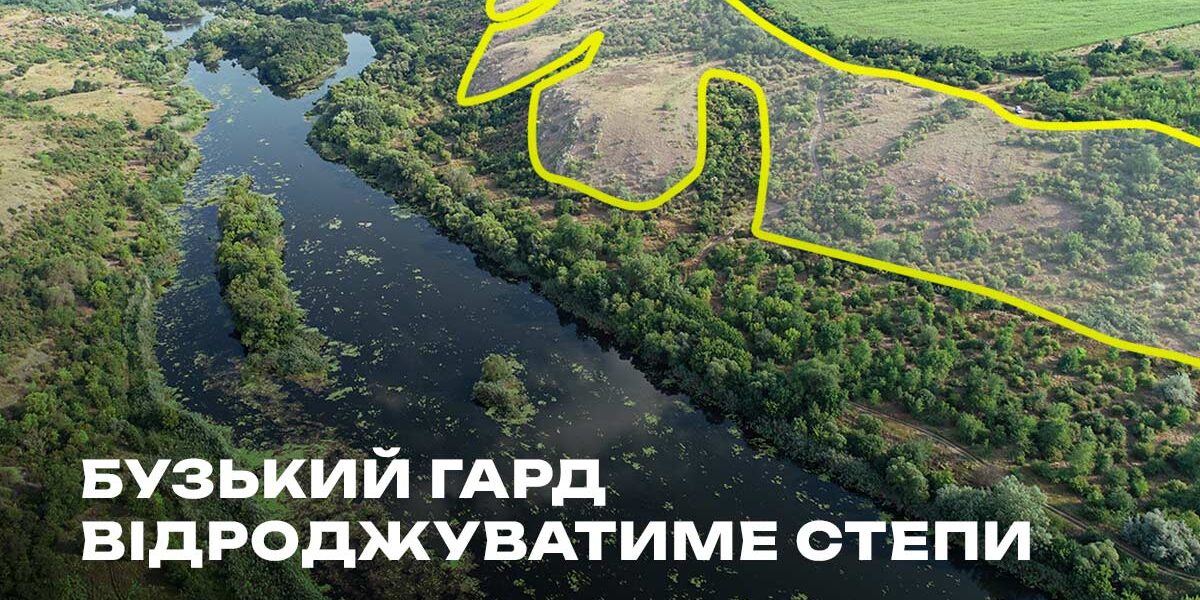
For our pilot project, we selected a site on the steppe slopes near the village of Myhiya in the Mykolaiv region, located within the Buzkyi Hard National Nature Park. This area is part of the Emerald Network (Site Code: UA0000040), and after Ukraine joins the EU, it is expected to be included in the Natura 2000 network. The site is extremely important for biodiversity, with a significant number of species that hold national and international conservation status. For example, the feather grass (Stipa) genus, of which all representatives are listed in The Red Data Book of Ukraine, is represented by ten different species on this site alone.
This territory has previously attracted the attention of scientists and conservationists. Since 2016, it has served as a training ground for various projects, including some supported by the European Commission. In 2018, its biotopes were mapped.
However, alongside this interest, scientists noted in 2018 that the area was being intensively overgrown by various tree and shrub species. Unfortunately, over the six years since mapping, the woody and shrub vegetation has significantly encroached on the steppe plots, leading to a reduction in the population of several rare species. The only way to save them is to maintain the steppe habitats, which requires immediate action to clear the woody vegetation and ongoing management of the cleared areas.
The pilot area was included in the National Nature Park without being removed from the land user, the state-owned enterprise “Forests of Ukraine.” Therefore, the project requires the preparation of permits and their coordination with the land user. Furthermore, for the long-term maintenance of the steppe vegetation after clearing (and in other valuable steppe areas in the park and the region), a number of socioeconomic issues must be addressed. These issues are the root causes of the decline in the traditional use of natural pastures and hayfields, which leads to their overgrowth by trees and shrubs.
We are developing an action plan for the conservation of natural steppe habitats in southern Ukraine. We’ve scheduled meetings with stakeholders for next spring, and our collaboration will help determine how best to restore steppe biotopes. The successful restoration of these steppes will allow us to scale up similar work to much larger areas in the future.
The development of the action plan and the pilot clearing project are being carried out as part of the Life “Conservation of Natural Heritage for Life in Ukraine” project.