
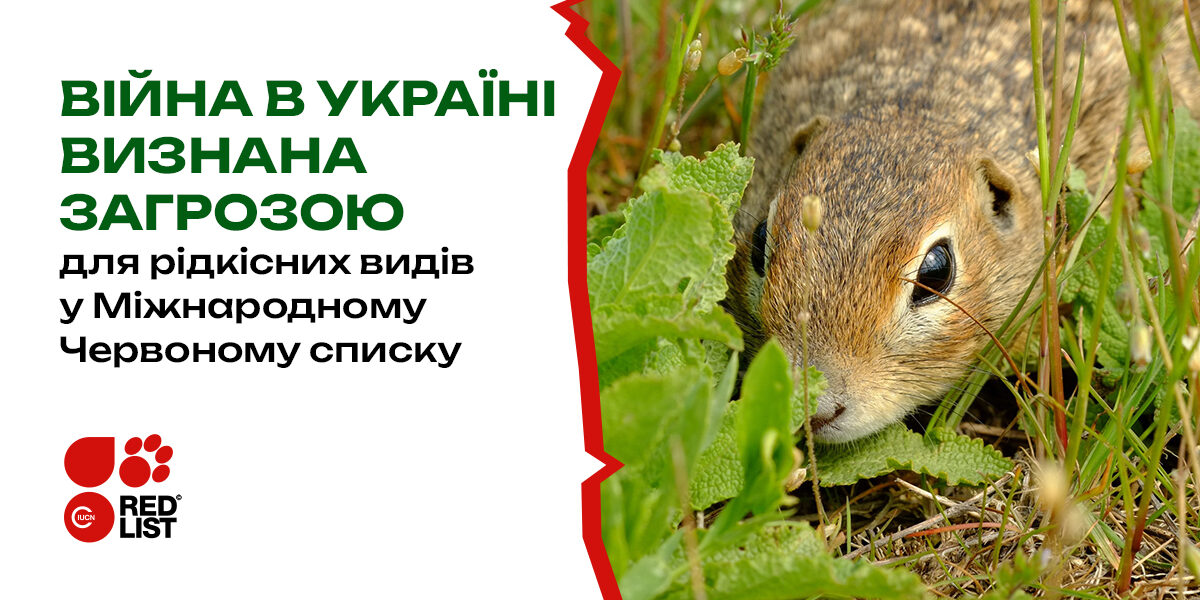
The IUCN European Red List has for the first time officially recognized the russian aggression in Ukraine and the russian terrorist attack on the Kakhovka HPP as threats to the survival of six mammal species. Ukrainian experts, including members of the Ukrainian Nature Conservation Group (UNCG), were actively involved in this groundbreaking update, which provides a new perspective on how military actions directly threaten biodiversity. Most of the species included in the new edition have significantly worsened their conservation status. However, while war is a key factor in the decline of these species, we must not forget that the plowing of the last remaining steppes poses an even greater threat to wild fauna.
The species included in this list are:
- Lesser mole-rat (Spalax leucodon) – Endangered
- Podolsk mole-rat (Spalax zemni) – Endangered
- Common mole-rat (Spalax microphthalmus) – Endangered
- Speckled ground squirrel (Spermophilus suslicus) – Critically Endangered
- European ground squirrel (Spermophilus citellus) – Critically Endangered
- Steppe lemming (Lagurus lagurus) – Vulnerable
This update has a crucial global context: it is the first time the consequences of war have been officially listed as a direct factor influencing a species’ extinction risk. Previously, discussions were limited to the general negative trends of military actions on biodiversity in long-term conflict zones. The IUCN report for Nordmann’s mouse-like hamster, for example, notes that the war has been a catastrophe for this species, potentially leading to the destruction of up to 70% of its global population, with the Kakhovka Dam explosion partially destroying its habitats.
It’s expected that other groups of Ukrainian animals may also see their conservation status worsen due to the impact of military actions. The actions of Russia in Ukraine, particularly the hostilities and the act of terrorism at the Kakhovka HPP, have caused severe damage to biodiversity, pushing unique species found only in Ukraine to the brink of extinction. These species urgently need protection, and their habitats need to be designated as Protected Areas. At a minimum, one of the key conservation strategies is a significant expansion of the Nature Reserve Fund, even in currently occupied territories.