
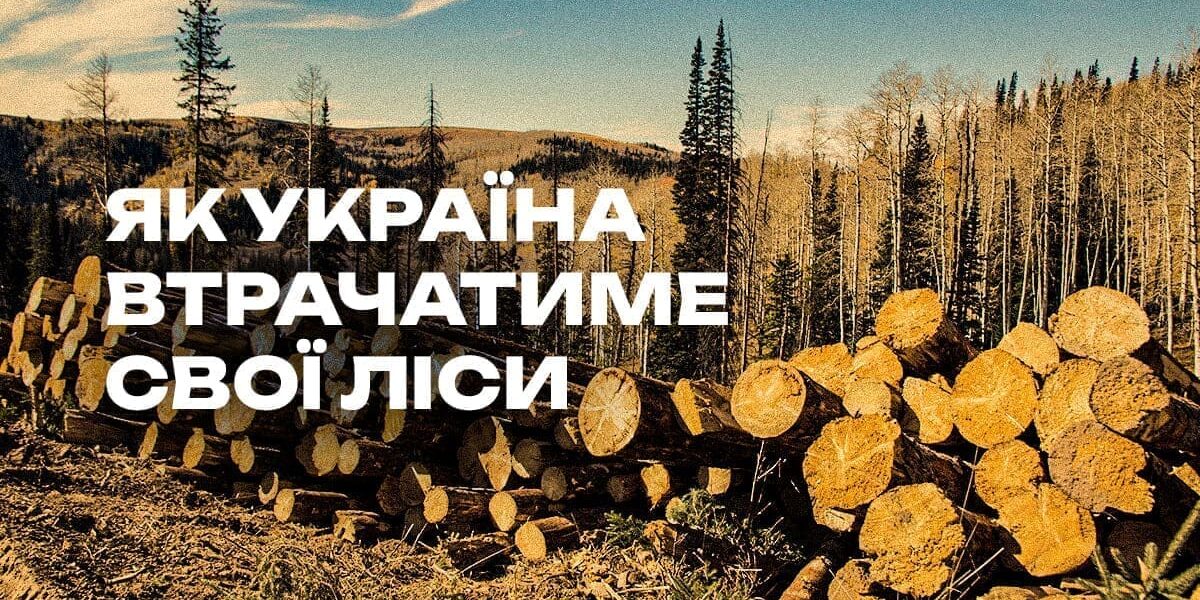
“Forests of Ukraine” wants to cut down more timber. They claim that Ukraine’s strict environmental regulations prevent them from “utilizing the resource potential of forests.” As usual, the foresters neglect to mention the consequences of their plans.
For example, the highly publicized construction of forest roads is a push to access forests where logging was previously impossible. In the Carpathian Mountains, there are still forests that have seen almost no logging. These are referred to as old-growth forests. The roads “Forests of Ukraine” is building often lead directly to them. Soon, almost none of these forests will remain.
The most valuable old-growth forests are called primeval forests. “Forests of Ukraine” is refusing to protect not only the primeval forests recently discovered by scientists, but also those they had previously agreed to protect. The plans to increase logging threaten hundreds of animal and plant species from The Red Data Book of Ukraine.
“Forests of Ukraine” has a chronic problem with this. The foresters themselves ignore the presence of Red Data Book species to avoid restrictions on logging. If an outsider discovers these species, the standard response is “there is a state of war, and it is forbidden to enter the forests.”
The most effective tool for protecting old-growth forests and Red Data Book species is the establishment of protected areas. However, on land managed by “Forests of Ukraine,” this requires their approval. Unsurprisingly, foresters, who are primarily concerned with increasing logging, almost never agree to the establishment of protected areas.
As a result, the protection of many valuable forests — such as the Chornyi Lis (Black Forest) in the Kirovohrad region, the Dermano-Ostrohskyi massif in the Rivne region, and the Verkhovynskyi National Nature Park—has been stalled for decades. Meanwhile, the most valuable parts of these forests are being destroyed.
In their publications, “Forests of Ukraine” mentions new forest roads or equipment but conveniently forgets other methods of increasing logging volumes. This includes the controversial “sanitary logging,” which is used in areas where planned logging is prohibited. Another method is “scientific” experiments in the forests. In practice, this amounts to the destruction of the most valuable forests through “experimental” logging schemes like “reformation logging.”
Currently, the foresters are lobbying for legislative changes that would legalize new, almost unlimited, experimental logging. Previous “studies” of this kind resulted in the harvesting of 1,800 trucks of timber in 2023, which attracted the attention of law enforcement agencies.
Unfortunately, with this approach to managing state forests, we risk turning them into monotonous pine plantations. We are already feeling the consequences, including climatic ones. The question is not whether it is appropriate to log more. The question is how to save our forests. Perhaps the top priority is to protect the remaining old-growth forests as quickly as possible.
Yehor Hrynyk